


Home Insulation and HVAC Performance: How They Work Together in Winter
As a Hamilton homeowner, you know the routine: the sky turns gray, the wind picks up off Lake Ontario, and you head straight for the thermostat. But have you ever considered that your HVAC system is only half of the equation?
At Dynamic Heating and Cooling, we often tell our clients that a house is a single, interconnected system. Think of your furnace or heat pump as the "engine" and your insulation as the "chassis." If the chassis has holes, it doesn't matter how powerful the engine is—you're going to lose speed (and money).
In this comprehensive 2026 guide, we’ll explore the powerful synergy between home insulation and HVAC performance. We'll look at the technical "why," the real-world "how," and the specific steps you can take in Hamilton to ensure your home stays cozy while your energy bills stay low.
1. The "Thermos Effect": Why Insulation is Your HVAC’s Best Friend
The easiest way to understand the relationship between insulation and HVAC is the "Thermos" analogy. If you put hot coffee in a high-quality Thermos, it stays hot for hours without any extra energy. If you put it in a thin ceramic mug, it’s cold in twenty minutes.
Your home works the same way.
HVAC Role: To generate heat and move it through the house.
Insulation Role: To act as a thermal barrier, slowing down the rate at which that heat escapes to the cold outdoors.
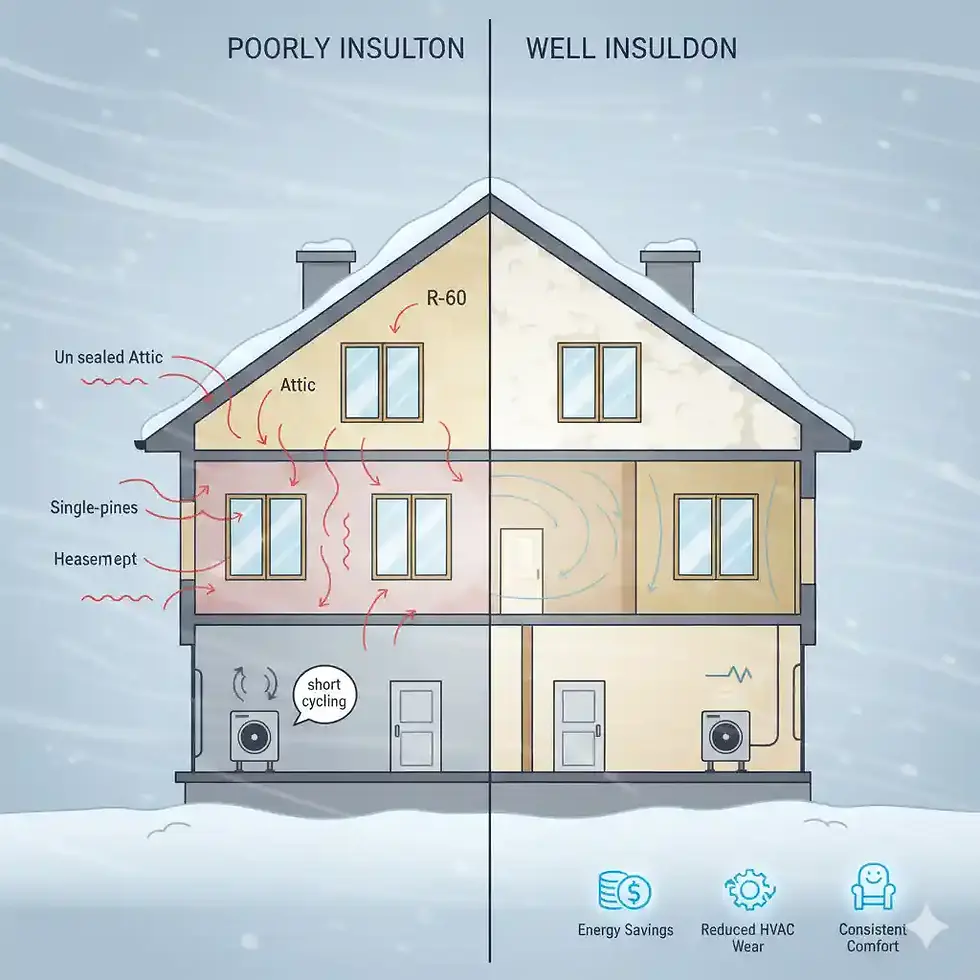
When your home is well-insulated, your heating system doesn't have to work as hard. It reaches the set temperature quickly and stays there, leading to fewer "on-off" cycles. This doesn't just save energy; it significantly reduces the wear and tear on your equipment, potentially adding years to your system's lifespan.
2. Identifying the "Great Escape": Where Hamilton Homes Lose Heat
In the Greater Hamilton Area, many of our homes—especially those in older neighborhoods like Westdale or the Delta—were built before modern energy standards. Even if you have a top-of-the-line HVAC replacement, you might be losing heat in these key areas:
The Attic (The Top Priority): Because heat rises, an under-insulated attic is the #1 culprit for high heating bills. In 2026, Ontario building codes recommend an R-value of R-60 for attics.
The Basement Rim Joist: This is the area where your home sits on its foundation. It’s a common spot for air leaks that bring cold drafts directly into your living space.
Walls and Outlets: Have you ever felt a draft coming from an electrical outlet? That’s a sign of a "void" in your wall insulation.
Windows and Doors: While not technically "insulation," they are part of the thermal envelope. Upgrading to triple-pane glass is a game-changer for Hamilton’s windy winters.
3. The Science of "Short Cycling" and HVAC Strain
When a home has poor insulation, the heat escapes almost as fast as the HVAC system can provide it. This leads to a phenomenon called Short Cycling.
Short Cycling occurs when your furnace or heat pump turns on, runs for a few minutes, shuts off, and then turns back on almost immediately.
Efficiency Loss: HVAC systems are least efficient during the first five minutes of operation (the "startup" phase).
Part Failure: Constant starting and stopping puts massive strain on the igniter, the blower motor, and the compressor.
Uneven Heat: You end up with "hot spots" near the vents and "cold spots" by the walls.
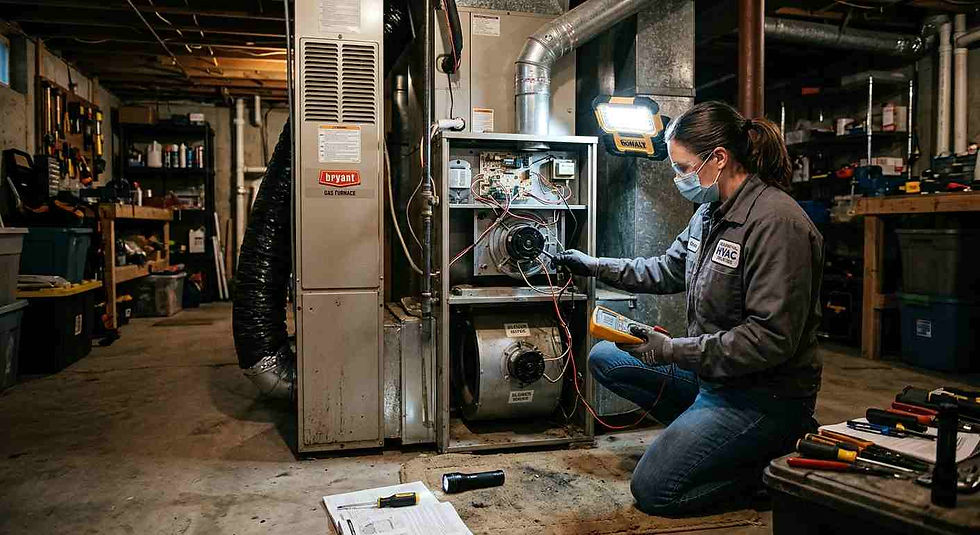
By investing in proper insulation, you allow for longer, more efficient run times. If you suspect your system is short cycling, it’s time to book an HVAC inspection to see if the issue is mechanical or related to your home's envelope.
4. Humidity Control: The Secret Link Between Insulation and Comfort
In Hamilton, winter isn't just cold; it can be surprisingly damp or bone-dry depending on the day. Your HVAC system works with your insulation to manage this.
Preventing Condensation: When warm, moist indoor air hits a cold, uninsulated wall, it turns into water (condensation). Over time, this leads to mold and structural rot.
The Role of Air Sealing: Insulation works best when paired with air sealing. Sealing gaps around pipes and wires prevents the "chimney effect," where cold air is sucked in through the basement and warm air is pushed out through the attic.
If your home feels "drafty" even when the windows are closed, you likely have an air-sealing issue. This is something we look for during any hvac maintenance visit, as air leaks often bypass your air filters, bringing dust and allergens directly into your system.
5. Heat Pumps and Insulation: A Critical Synergy
In 2026, many Hamiltonians are switching to heat pump replacement units to save on carbon taxes. However, a heat pump’s performance is uniquely tied to insulation.
Unlike a gas furnace, which produces "blast" heat (very high temperature for short periods), a heat pump provides a steady, lower-temperature flow of air.
In a well-insulated home: The heat pump maintains a perfect, consistent temperature with incredible efficiency.
In a poorly insulated home: The heat pump may struggle to keep up during a "Polar Vortex," forcing it to switch to expensive "Auxiliary" electric heat.
If you are planning to upgrade to a heat pump, we highly recommend an energy audit first. Ensuring your attic is topped up can be the difference between your heat pump being a "money-saver" or a "money-pit."
6. Actionable Tips: The "Home Performance" Checklist
To get the most out of your HVAC system this winter, follow these steps:
The "Touch Test": On a cold day, touch your interior walls. They should feel warm. If they feel like a refrigerator, you have an insulation gap.
Check the Attic Hatch: Most people insulate their attic but forget the "door" to get into it. Ensure your attic hatch is weather-stripped and has a piece of rigid foam insulation on top.
Seal the Rim Joists: Use spray foam or rockwool to seal the gaps in your basement where the wood meets the concrete.
Book a Seasonal Tune-Up: Ensure your furnace is running at peak efficiency so it can take full advantage of your home’s "Thermos effect."
7. 2026 Hamilton Rebates: Saving on the Synergy
The government of Canada and local utilities understand that insulation and HVAC must work together. In 2026, the Enbridge Home Efficiency Rebate Plus (HER+) continues to offer significant incentives for homeowners who perform a "Whole Home" upgrade.
By combining insulation upgrades with a high-efficiency heat pump installation, Hamilton residents can often access thousands of dollars in rebates. At Dynamic Heating and Cooling, we can walk you through the process and connect you with certified energy advisors in the city.
Summary: Comfort is a Team Sport
Your HVAC system and your home's insulation are a team. One provides the energy, the other preserves it. When they work together, you get:
Lower monthly utility bills.
A quieter home (insulation is a great sound dampener!).
A longer-lasting HVAC system.
Consistent comfort in every room.
Don't let your hard-earned heat vanish into thin air. If your home is struggling to stay warm, the problem might be more than just your furnace. Contact Dynamic Heating and Cooling today at 289-204-3358 for a full system evaluation. We’ll help you determine if you need a heat pump repair, a system replacement, or if a few bags of insulation are the missing piece of the puzzle.


Comments